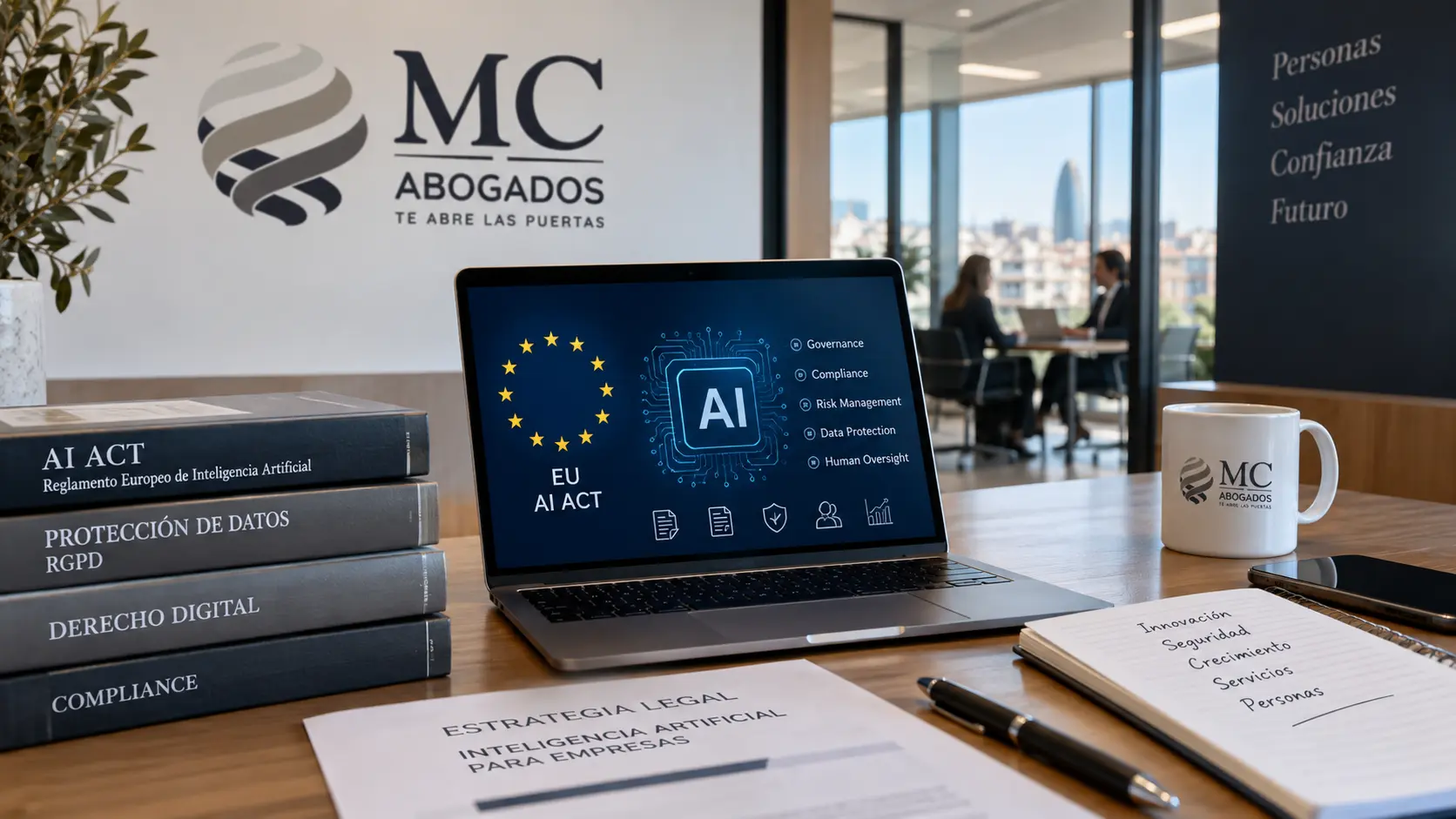

Artificial intelligence is transforming the practice of law and business operations. Its ability to optimize processes offers great opportunities, but it also requires accountability, human oversight, and a proper understanding of its legal risks.
Artificial intelligence is no longer a matter for the future in the legal profession. It is a reality that is transforming the way we conduct research, draft documents, manage information, and organize our daily work.
Tools such as vLex, chatbots, email managers, and other AI-based solutions help streamline tasks, locate information, review documentation, and optimize processes. Ultimately, they allow us to gain something particularly valuable in our profession: time.
But the adoption of these technologies also raises a fundamental question:
How far can artificial intelligence go in legal practice, and where must the lawyer’s judgment necessarily come into play?
The answer is beginning to take shape in our courts as well.
In February 2026, the High Court of Justice of the Canary Islands fined a lawyer 420 euros for including as many as 48 false case law citations in an appeal, which had been generated using artificial intelligence.
The problem was not the use of AI, but rather the presentation of those references without verifying them. This case highlights that while the tool can assist professionals, the responsibility for the content presented in court remains with the attorney.
For its part, the High Court of Justice of Navarre examined another case in 2024 in which provisions of the Colombian Penal Code—which are foreign to the Spanish legal system—had been incorporated due to the improper use of ChatGPT 3. On that occasion, the Court took into account the acknowledgment of the error, the apology, and the steps taken to correct it, and decided to dismiss the separate liability proceeding.
Both situations teach us a clear lesson:
Artificial intelligence can be an extraordinary tool, but it is no substitute for professional diligence.
The speed with which a tool generates a response does not guarantee that its content is correct. A non-existent case law reference, an erroneous interpretation of the law, or an unverified document can have consequences that go far beyond the time one intended to save.
For this reason, the use of AI in the legal field requires an understanding of both its capabilities and its limitations.
I believe that the use of these technologies in the practice of law should be based on at least four fundamental principles.
All content generated or assisted by artificial intelligence must be verified before being used professionally.
Technology can facilitate research and the preparation of documents, but verifying their accuracy and relevance to the matter must continue to be done under professional supervision.
The greater the significance of the legal act—especially in pleadings—the higher the level of verification must be.
Not all tasks present the same risks. Using AI to organize internal information does not carry the same implications as relying on it to substantiate a claim, interpret a contractual obligation, or prepare a defense strategy.
When a mistake occurs, acknowledging it and correcting it immediately is also part of professional responsibility.
Technology does not eliminate the possibility of making mistakes. What matters is establishing mechanisms to detect errors, act diligently, and prevent them from recurring.
Artificial intelligence can no longer be considered an unknown novelty.
Law firms must learn to use it, understand its limitations, and establish control mechanisms that allow us to critically evaluate its results.
Ongoing training and the responsible use of these tools are essential to reaping their benefits without compromising the standards required by our profession.
Although these examples come from the legal field, this discussion is also relevant for companies that are incorporating artificial intelligence into their processes.
Today, a startup can use AI to analyze documents, an SME can automate certain communications, and a larger company can integrate intelligent tools into its human resources, administrative, or customer service departments.
The opportunities for efficiency are clear. However, automation can also raise issues related to the protection of personal data, confidentiality, contracts, intellectual property, or decisions that affect employees and customers.
Not all AI applications pose the same risks or are subject to the same obligations. The European Artificial Intelligence Regulation (Regulation (EU) 2024/1689), along with other applicable regulations, requires attention to be paid to the type of system used, its purpose, and the responsibilities of those who develop or use it.
Therefore, before incorporating a tool into a business process, it is advisable to understand its legal implications and establish appropriate controls.
Technological innovation and legal certainty should not be viewed as conflicting goals. Responsible implementation allows us to reap the benefits of AI without losing sight of individuals’ rights or the organization’s obligations.
At Martinez Caballero Abogados, we are committed to innovation without compromising on issues that are particularly sensitive to our clients, such as confidentiality, personal data protection, non-discrimination, and the right to a defense.
We do not want to be left behind in this transformation. We have taken the initiative to move forward in this area, combining training, experimentation, and practical application, while maintaining a cautious interpretation of the regulatory and ethical framework that governs us.
That is why we promote training led by specialized professionals and, at the same time, explore and incorporate tools that can help us optimize our daily work, automate certain tasks, and make better use of our time.
We understand that incorporating artificial intelligence is not just about adopting new technologies. It also involves knowing when to use them, how to monitor their results, and in which situations professional judgment must take precedence.
For every client, it remains essential to understand their situation, evaluate the options, develop a strategy, take responsibility, and provide legal advice based on experience, sound judgment, and trust.
This perspective is also relevant for companies that need to make legal decisions in an increasingly digitized environment. Technology can streamline processes and provide information, but interpreting its implications and deciding how to proceed still requires professional expertise.
That is why we do not believe the future lies in a conflict between lawyers and AI.
We believe the future lies in lawyers working with AI, using technology as a tool to do our jobs better—not to replace what constitutes our true value.
Legal decision-making, strategy, and professional responsibility continue to revolve around one indispensable figure: the lawyer.
Because artificial intelligence can help us work faster. But it is human legal judgment that allows us to do it better.
Daniellie Hernández
Administrative Assistant in the Customer Service Department. Attorney (Venezuela).